




Constant originally titled this work To Us, Liberty, believing that it encapsulated the spirit of creative freedom that accompanied the founding of the CoBrA group in 1948. The prominent use of red, white and blue allude to the French tricolour flag, and its revolutionary values of Liberty, Equality and Brotherhood. Several years later, after the collapse of CoBrA, Constant re-titled the work to reflect his disillusionment: ‘I changed the title to express my doubts about the possibility of ‘free art’ in an unfree society, and, at the same time, my hopes for the freedom all men are looking for.’

2009년 1월 28일 수요일
2009년 1월 25일 일요일
Normann Copenhagen - Plane

A simple, almost childlike form combined with happy colours and wood. Normann Copenhagen presents Plane – a wooden aeroplane designed by Ole Søndergaard for children of all ages. The story of Plane is about happiness, freedom and daring to dream. It is about the inner feelings of freedom and joy that you experience when you set out on new adventures – be they in fantasy or in reality.
In the summer of 2005 Ole Søndergaard wrote the following in his diary: “Above me, in the distance can be heard the sound of the engine of a little sports plane. It is summer and the air is completely still. The sky is a brilliant blue and as always I am drawn when I see a plane in the sky. With an almost childlike joy I can permanently forget both time and place and soar up into the wide blue yonder".
This is how Plane came about. The extremely simplistic, minimalistic and almost symbolic approach to product design is not unknown but is rather characteristic of Ole Søndergaard’s work. Honoured with design prizes and distinctions he has during the course of his career created innumerable pictograms, logos and the font ‘FF Signa’.


Gitta Gschwendtner's Bag stools

그녀는 보통의 종이 쇼핑백을 뒤집어 이를 주형틀로 삼아, 그 안에 콘크리트와 나무섬유의 혼합물을 부어 굳혀 의자를 만들어냈다. 쇼핑백의 모습 그대로가 의자의 형태가 되고, 쇼핑백 밑바닥이 시트가 된다. 의자의 모습이 어딘가 익숙해 보인 이유도 여기에 있다.


www.gittagschwendtner.com
2009년 1월 24일 토요일
Constant (Constant. Nieuwenhuys) - After Us, Liberty

After us, Liberty, 1949
(From the display caption August 2004)
Henry Moore - Helmet Head No.1, 1950


Helmet Head No.1, 1950.
"...Just as the outbreak of hostilities in Korea threatened to escalate into a wider international conflict, and may reflect moore's anxieties over the threat of nuclear war."
Jannis Kounellis

Untitled, 1979

Untitled. 1983
Jannis Kounellis was born on March 23, 1936 in Piraeus, Greece. He studied at the Accademia di Belle Arti in Rome.
In 1963, the artist introduced found objects in his paintings, among them live animals but also fire, earth, burlap sacks, gold. He replaced the canvas with bed frames, doorways, windows or simply the gallery itself. In 1967, Kounellis joined the Arte Povera movement of Germano Celant. In 1969, he exhibited real horses in the galleria l’Attico. Graudually, Kounellis introduced new materials in his installations (smoke, coal, meat, coffee grinds...). The gallery environment was replaced with historical (mostly industrial) sites.
Mark Tobey and Jackson Pollock
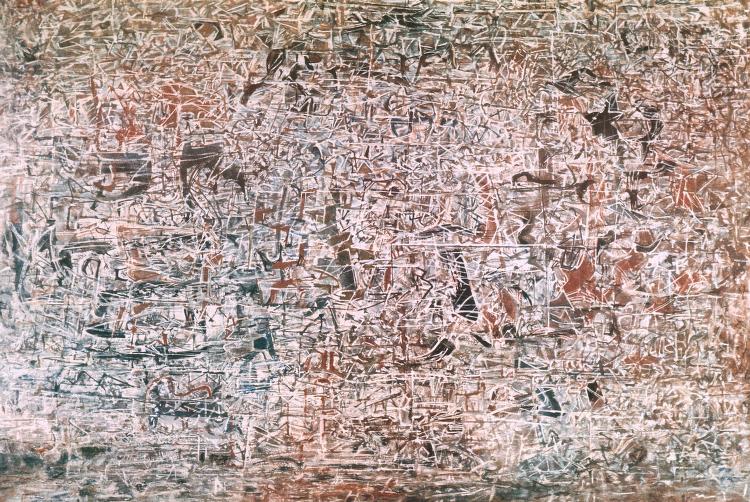
Mark Tobey - Patterns of Conflict, 1944

Jackson Pollock - Number 1, 1950 (Lavender Mist)
HANS ARP - Le soleil recercle

HANS (OR JEAN) ARP
(born in Strasbourg, then Germany, now France, 16 September 1886; died in Basel, Switzerland, 7 June 1966)
Arp, who used alternatively Hans and Jean as his first name, was born in Alsace, a region contended for centuries by Germany and France. Like most Alsatians, he spoke both German and French, and also the local dialect. His work often reflected this very deep dualism, most clearly in the split between poetry and visual art.
From the beginning of his career Arp was interested in abandoning realism and experimenting with formal simplification and abstraction, often with spiritual nuances. Yet his works always retained some identifiable link with the natural world, as he believed that art could help reconcile man with nature. The human form is widely considered to be at the heart of his work.
Arp explored the creative potential of 'chance', most famously in the collages he made by ripping paper sheets and arranging them automatically, abandoning himself to the forces of the subconscious. He was a co-creator of Dada in Zurich in 1916, and later contributed actively to Surrealism and Constructivism. For over five decades he worked in a wide variety of media, including collage and painted reliefs (from 1914), sculpture (from 1930), graphic work and poerty.
피드 구독하기:
덧글 (Atom)